

We research everything we recommend. When you buy through our links, we may earn a commission. Learn more

Buying guide · 10 min read · Updated October 2, 2026

5 Best Solar Charge Controller For Lithium Batteries in 2026: A Practical RV Guide

Five solar charge controllers that list lithium support, compared on cold-weather charging, battery chemistry options and array size for RV owners.

Bowen HigginsBy Bowen HigginsRV Editor at RV Gear Lab5 products comparedSpec-sheet researched

At a glance

Our top picks

Lithium batteries are less forgiving than lead-acid, so the right controller has to offer the right voltage and ideally some cold-weather protection. This guide compares five controllers whose listings name lithium, from a premium 40A MPPT with low-temperature protection to inexpensive PWM units that rely on your battery's own BMS.

Rather than ranking only on amps, this guide looks at which listings mention cold behavior, which name lithium-ion versus LiFePO4 and which leave the temperature question to the battery. Listings that are silent on cold charging are flagged.

RV Gear Lab field notes

The Rig Fit Check

Start with the job
Renogy Solar Charge Controller Rover 40A 12V24V Auto Parameter DC Input MPPT Charge Controllers for Solar Pane leads this shortlist for Cold-weather lithium. Use that fit as a reference point, then compare the alternatives against your own space and workload.
Specs that separate the picks
The first details to compare are 40A MPPT, 12V/24V auto, 100A MPPT, 12V to 48V, 20A PWM, 12V. Confirm the exact model and included components before ordering.
Trade-off to plan for
Bluetooth hardware may be separate

Before you buy

What Matters Before You Choose a Solar Charge Controller For Lithium Batteries

Key buying criteria so you get the right fit the first time.

  1. 01

    Lithium chemistry named

    LiFePO4 and lithium-ion cells charge to different voltages, so a controller that lists both or lets you set voltage is safer. Using the wrong profile can undercharge or damage cells. Look for the exact chemistry on the listing and match it to your battery.

  2. 02

    Low-temperature charge cut-off

    Charging lithium below about 32F can plate lithium and shorten life. Some controllers cut off at low temperature while others leave it to the battery's BMS. Check the listing for a low-temperature feature or confirm your battery has one.

  3. 03

    Operating temperature range

    A controller rated across a wide range, such as -40F to 149F, keeps working on hot roofs and cold mornings. Narrow ranges can shut down early. Look for the range in the spec sheet rather than a vague all-weather label.

  4. 04

    Array voltage and amps

    A high-amp unit like ELUSH 100A can accept big arrays but needs thick wire. Add up panel watts and divide by battery voltage to pick a rating, and check the maximum PV voltage. Do not exceed the PV limit on a cold morning.

  5. 05

    Verification on setup

    Because some listings are thin, measure the battery voltage during absorption with a multimeter. Compare it with your battery's datasheet and adjust the profile if you can. This check works for any of these units.

Our standards

Why You Can Trust RV Gear Lab

At RV Gear Lab, we compare products based on rig fit and power or hookup compatibility, verified specifications, usability, setup requirements, weight, durability, and real-world trade-offs. We do not rank products purely on marketing claims or commission rates.

We have not personally tested every product listed. Where hands-on testing is not available, recommendations are based on verified manufacturer specifications, product documentation, use-case fit, and comparative research.

How we review RV gear →

Detailed reviews

The 5 best solar charge controller for lithium batteries, explained

01
Best for: Cold-weather lithium

Our take

Best for a lithium-equipped RV used in cold climates.

Why it made the shortlist

The Rover 40A is a 12V/24V auto-detecting MPPT controller with 98% conversion and 99% tracking efficiency listed. It operates from -40F to 149F with built-in low-temperature protection and a four-stage charge.

What works

  • Operates from -40F to 149F with low-temp protection
  • Four-stage MPPT with 12V/24V auto-detect
  • Rust and corrosion resistant build
  • App-adjustable settings listed

Watch out for

  • Bluetooth hardware may be separate
The catch
It costs more than ELUSH 100A or EpRec 30A but gives you tracking efficiency of 99% and four-stage charging.
02
Best for: High-amp lithium

Our take

Best for a large lithium system that may change voltage later.

Why it made the shortlist

ELUSH's 100A MPPT lists up to 100V PV input and works across 12V to 48V systems. ELUSH's 100A MPPT controller accepts up to 100V of PV input and handles 12V, 24V, 36V and 48V systems. A backlit LCD with a clock shows data across seven operating modes, and voltage and current protections are listed.

It suits big or multi-voltage systems more than a typical trailer.

What works

  • Auto-detects 12V, 24V, 36V and 48V
  • Backlit LCD with a clock
  • Battery over-voltage and over-current protection

Watch out for

  • 100V limit constrains long series strings
  • 100A is oversized for most RV roofs
The catch
It is far larger than Renogy Rover 40A and costs much less, but it lacks a stated cold-weather feature.
03
Best for: Small 12V lithium

Our take

Best for a small 12V lithium setup with a modest array.

Why it made the shortlist

AeternaSol's 20A PWM targets LiFePO4, AGM and gel on 12V with Type-C and USB outputs. The listing claims zero idle drain and reverse-current protection from an upgraded core circuit.

Against Peidesi 30A PWM it adds device charging ports.

What works

  • Zero idle drain on the battery
  • Reverse-current protection listed
  • Type-C and USB ports for devices
  • Works with LiFePO4, AGM and gel batteries

Watch out for

  • 12V only, with no 24V option
  • 20A limits array size to a few panels
The catch
It is smaller than EpRec 30A and drops 24V, but it lists zero idle drain.
04
Best for: Mixed chemistries

Our take

Best for mixed chemistry experiments on a 12V or 24V budget.

Why it made the shortlist

EpRec's 30A PWM names lithium-ion, lithium iron phosphate and lead-acid, with four-stage charging. EpRec's 30A PWM controller covers 12V and 24V systems with four-stage charging and names lithium-ion, lithium iron phosphate and lead-acid (open, AGM, gel) batteries. A backlit LCD shows PV, battery and load data, and dual USB ports supply 5V 2.5A.

Compared with Peidesi 30A PWM it adds dual MOSFET reverse protection and USB ports.

What works

  • Names lithium-ion and lithium iron phosphate
  • Four-stage PWM charging
  • Dual MOSFET reverse-current protection
  • Backlit LCD plus dual USB at 5V 2.5A

Watch out for

  • PWM, so extra panel voltage is lost
  • Equalization stage is for lead-acid only
05
Best for: Budget lithium

Our take

Best for a budget setup with a battery that has its own BMS.

Why it made the shortlist

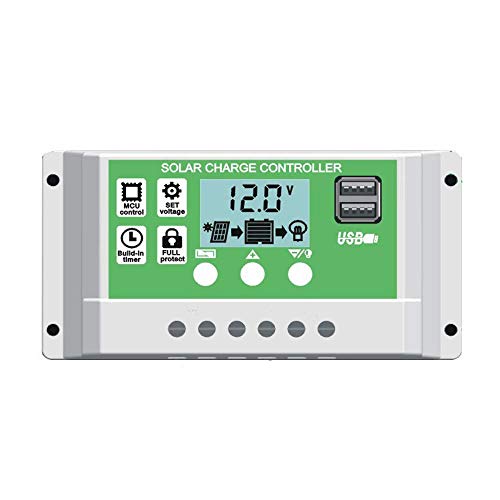
Peidesi's 30A PWM lists LiFePO4, lithium, gel and lead-acid for panels from 100W to 300W. Peidesi's 30A PWM controller is automatically compatible with 12V or 24V systems and suits LiFePO4, lithium, gel and lead-acid batteries. It has a large LCD for switching modes and adjusting parameters and is described for 100W to 300W panels.

It is a low-cost general-purpose 30A PWM for small trailers.

What works

  • Auto-compatible with 12V or 24V systems
  • Large LCD for modes and parameters
  • Industrial microcontroller memorizes settings
  • Overcurrent and reverse protection

Watch out for

  • Sized for 100W to 300W of panels
  • PWM design wastes extra panel voltage

Methodology

How We Built This Shortlist

Each pick was assessed across 5 criteria weighted for real-world use.

01

Lithium chemistry coverage

This guide checks which listings name lithium-ion, LiFePO4 or both rather than just calling a unit lithium compatible.

02

Cold-charge behavior

Low-temperature protection and operating ranges were compared, since charging a frozen lithium battery can damage it.

03

Tracking and capacity

MPPT and PWM options were weighed against typical RV array sizes.

04

Extras

Display, USB ports and reverse protection were considered as secondary factors.

05

Listing clarity

Missing details such as cold behavior are flagged so you can verify them.

Decision guide

Match a Solar Charge Controller For Lithium Batteries to Your RV

By Cold-Weather Need

Your situationRecommended pickWhy
Winter camping with lithiumRenogy Rover 40ALow-temperature protection listed.
Mild climate, small 12V arrayAeternaSol 20A20A with zero idle drain.
Mixed chemistry on a 12V or 24V bankEpRec 30ALithium-ion and LiFePO4 listed.
Large array on a multi-voltage bankELUSH 100A12V to 48V auto detect.
Budget unit with battery-side BMSPeidesi 30A PWM30A for 100W to 300W panels.

By Budget

BudgetRecommended pick
$10 to $20EpRec 30A or Peidesi 30A PWM
$20 to $50AeternaSol 20A or ELUSH 100A
$140 to $150Renogy Rover 40A

Controller Cut-Off vs Battery BMS

Controller cut-off

A controller that stops charging in the cold protects any battery you connect. Renogy Rover 40A is the one pick here that lists it.

Battery BMS

Many lithium batteries block cold charging themselves, which makes the controller feature redundant. ELUSH 100A, AeternaSol 20A, EpRec 30A and Peidesi 30A PWM rely on this.

Choose Renogy Rover 40A if your battery lacks a low-temp BMS, and otherwise pick the unit that best fits your array.

By Regulation Type

TypeRecommended pick
MPPT with cold-weather featuresRenogy Rover 40A
MPPT with big capacityELUSH 100A
PWM, 12V onlyAeternaSol 20A
PWM, 12V or 24VEpRec 30A

For Four-Season Lithium Rigs Specifically

Look for

Look for low-temperature protection, a wide operating range and a lithium profile that you can verify with a meter.

In this comparison

Renogy Rover 40A lists low-temperature protection and a -40F to 149F operating range, which none of the other picks match.

When to Spend More

Spend more if

Spend more if you camp in freezing weather without a battery-side BMS, where Renogy Rover 40A pays off.

Save if

Save if your lithium battery has its own BMS, where EpRec 30A or Peidesi 30A PWM covers a small array.

FAQ

Before You Bring One Home

Will any charge controller work with lithium?

Only if it can hold the right voltages. Look for lithium or LiFePO4 modes or adjustable voltage.

What mistake do buyers make with a lithium solar controller?

Charging in freezing weather without protection. Confirm your battery or controller blocks charging below about 32F.

Is Renogy Rover 40A worth the extra cost?

If you camp in the cold, yes, since it lists low-temperature protection. In mild climates, ELUSH 100A or EpRec 30A may be enough.

What is the safest way to wire a lithium solar controller?

Use a multimeter on the battery terminals during the absorption stage and compare with the datasheet. On a lithium solar controller, double-check polarity at every terminal before powering up and use wire sized for the rated amps.

How should I maintain a lithium solar controller?

On a lithium solar controller, tighten terminals and inspect cable insulation at the start of each season, and keep vents, fans or heat-sink surfaces free of dust. Check terminals and cable insulation each season, and review settings after any firmware or battery change.

Bottom line

The short version

Browse more solar charge controller for lithium batteries on Amazon →
Bowen Higgins, RV Editor at RV Gear Lab

About the author

Bowen Higgins

RV Editor at RV Gear Lab

Bowen covers RV power, water systems, towing and leveling, upkeep and interior comfort, with a focus on matching gear to the rig, the hookups and the way you actually travel.

More from Bowen →Editorial standards

Keep reading

Related guides