

We research everything we recommend. When you buy through our links, we may earn a commission. Learn more

Buying guide · 10 min read · Updated October 2, 2026

4 Best Solar Panel For Pop Up Camper in 2026: A Practical RV Guide

Pop up camper solar panels compared for lift roofs and tight storage: a Renogy 200W kit, a folding 200W panel, a DOKIO 100W and a Newpowa 35W kit.

Bowen HigginsBy Bowen HigginsRV Editor at RV Gear Lab4 products comparedSpec-sheet researched

At a glance

Our top picks

A pop up camper changes the solar rules, because the roof lowers onto a canvas box and a fixed panel can add weight to the lift or block the crank. Many owners keep panels off the roof and set them on the ground instead. This guide ranks four options that suit that reality, from a 200W roof kit to a folding 100W panel and a small 35W trickle kit, with notes on cable length, storage size and the daily watt-hours each one realistically adds.

RV Gear Lab field notes

The Rig Fit Check

Start with the job
Renogy 200W 12V N-Type RV Solar Panel Kit with Adventurer 30A Controller leads this shortlist for Pop ups with a hard roof or rack. Use that fit as a reference point, then compare the alternatives against your own space and workload.
Specs that separate the picks
The first details to compare are 200W N-Type kit, 200W, 8.82 lb, 100W, 6 lb. Confirm the exact model and included components before ordering.
Trade-off to plan for
Rigid panels add weight to a lift roof

Before you buy

What Matters Before You Choose a Solar Panel For Pop Up Camper

Key buying criteria so you get the right fit the first time.

  1. 01

    Roof weight and lift limits

    A pop up roof is lifted by hand or crank, and extra weight changes how hard it is to raise. Ask the maker for the roof load rating before bolting on glass. A 200W rigid pair adds many pounds, while a portable panel like the 8.82 lb Renogy adds none.

  2. 02

    Folded size versus storage

    A panel you cannot store is a panel you will leave at home. Folded dimensions decide if it fits behind a seat or in a dinette bin. Check the listing for folded size, such as 16.14 by 15.35 by 3.07 inches.

  3. 03

    Controller included or not

    Panels cannot charge a battery directly without a controller. Some portable panels are made for power stations and lack one. Look for a named controller type, like PWM, in the contents list.

  4. 04

    Cable length for shade

    Pop ups are often parked under trees, and short cables force the panel into shade. A longer lead lets you keep the controller cool and the panel in sun. Check for a stated length, such as 9.84 feet.

  5. 05

    Input limits of your battery

    A power station or controller caps how many watts it accepts, and extra panel output is wasted. For example, some stations cap input near 60W. Read your battery's input spec before buying a 200W panel.

Our standards

Why You Can Trust RV Gear Lab

At RV Gear Lab, we compare products based on rig fit and power or hookup compatibility, verified specifications, usability, setup requirements, weight, durability, and real-world trade-offs. We do not rank products purely on marketing claims or commission rates.

We have not personally tested every product listed. Where hands-on testing is not available, recommendations are based on verified manufacturer specifications, product documentation, use-case fit, and comparative research.

How we review RV gear →

Detailed reviews

The 4 best solar panel for pop up camper, explained

01
Best for: Pop ups with a hard roof or rack

Our take

It costs $51.31 more than the Renogy 200W Portable, and in exchange you get a fixed system with a real controller.

Why it made the shortlist

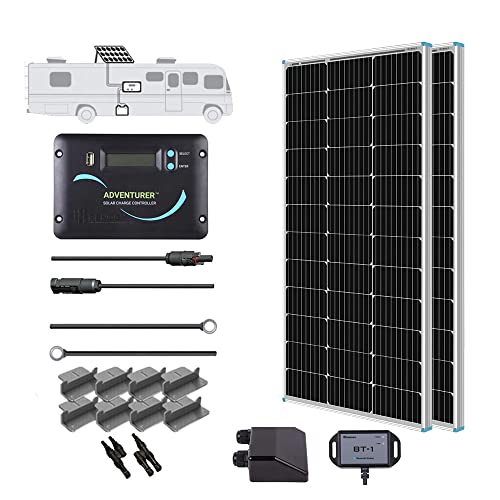
The Renogy 200W N-Type kit includes an Adventurer-Li 30A PWM controller designed for flush mounting on a camper wall, plus plug and play cables and Y branch connectors. The cells are rated at 22% efficiency, and Renogy quotes 800Wh a day at 4 hours of sun. The warranty is 5 years.

That makes it the better pick if your pop up has a hard roof or a rear rack that can carry about 200W. Pick this if you camp in one spot for days.

What works

  • Controller supports lithium, lead acid and gel banks
  • Plug and play cables and Y connectors included in kit
  • Five year warranty with phone and chat support

Watch out for

  • Rigid panels add weight to a lift roof
  • PWM controller leaves some energy on the table
02
Best for: Shaded campsites and power station users

Our take

It is designed for portable power stations, so check that your battery or station accepts the panel's output.

Why it made the shortlist

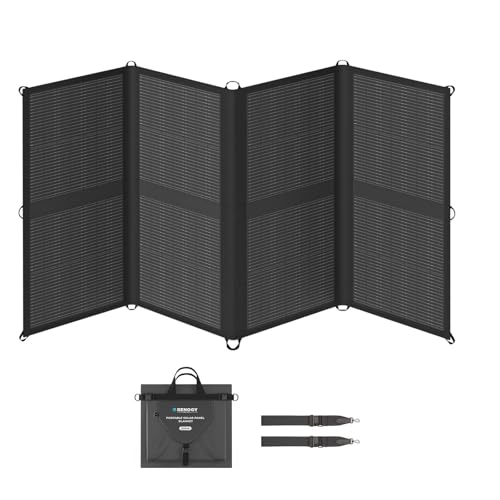
The Renogy 200W Portable folds in eight sections to 16.14 by 15.35 by 3.07 inches and weighs 8.82 lb. The 16BB N-Type cells are rated at 25% efficiency, and the IP65 case works between -10 and 65 degrees Celsius. It has USB-C and USB-A ports for devices.

Pick this if you want to place panels in the sun while the camper sits in shade.

What works

  • Folds small enough to store inside a pop up cabinet
  • Weighs 8.82 lb, so one person can carry it
  • Sets in sun while the camper stays in shade

Watch out for

  • Built for power stations, so a controller may be needed
03
Best for: Weekend trips on a budget

Our take

At $68.77 it is the cheapest full panel here, and it sits $21.98 above the Newpowa 35W Kit while making roughly three times the power.

Why it made the shortlist

The DOKIO Portable 100W folds to 19 by 26 by 0.5 inches, weighs 6 lb and includes a 9.84 foot cable plus a standalone PWM controller. The controller guards against reverse polarity, overcharge, overload and short circuit. USB ports supply small devices when the unit is on a battery.

Pick this if you need a simple 12V battery charger on a weekend pop up.

What works

  • Includes a separate PWM controller for 12V batteries
  • Folds to half an inch thick for tight storage
  • Long 9.84 foot cable lets the panel sit in sun

Watch out for

  • 100W gives only a few hundred watt-hours daily
  • Some power stations cap input below its 100W
04
Best for: Stored pop ups needing battery maintenance

Our take

The strongest case for Newpowa 10BB 35W 12V Solar Panel High-Efficiency Monocrystalline PV Module Designed for Off Grid System is keeps a stored battery topped up without effort.

Why it made the shortlist

The Newpowa 10BB 35W kit pairs a monocrystalline panel rated at 17.2V and 2.04A with a waterproof controller, and the listing gives it an IP67 rating. Pre-attached 3 foot leads and pre-drilled frame holes simplify mounting. It carries a 2 year workmanship warranty.

What works

  • Keeps a stored battery topped up without effort
  • Waterproof controller can live outside year round
  • Pre-drilled frame holes make a fixed mount easy

Watch out for

  • Too small to run a fridge or lights for days
  • Pre-attached leads are only 3 feet long

Methodology

How We Built This Shortlist

Each pick was assessed across 4 criteria weighted for real-world use.

01

Storage size

We compared folded or panel dimensions against typical pop up cabinet and bunk-end space.

02

Roof and lift weight

Panel weight was weighed against what a lift roof and its crank can reasonably carry.

03

Charging match

We checked controller type and whether the output suits a bare 12V battery or a power station.

04

Value

Price was divided by usable watts, then adjusted for what each package includes.

Decision guide

Match a Solar Panel For Pop Up Camper to Your RV

By Where You Mount

Your situationRecommended pickWhy
Fixed on a hard roof or rackRenogy 200W N-TypeRigid frames with a flush mount controller
Set on the ground in sunRenogy 200W PortableFolded 16x15x3 inchches and weighs 8.82 lb
Ground deployment for a 12V batteryDOKIO Portable 100WHas a PWM controller and a 9.84 foot cable
Permanent small trickle mountNewpowa 35W KitIP67 waterproof controller stays outside

By Budget

BudgetRecommended pick
$40 to $70Newpowa 35W Kit or DOKIO Portable 100W
$190 to $250Renogy 200W Portable or Renogy 200W N-Type

Fixed Roof Panel vs Portable Panel

Fixed

The Renogy 200W N-Type and Newpowa 35W Kit stay mounted, charge while you drive or hike, and never need setup. They add weight and cannot chase the sun.

Portable

Renogy 200W Portable and DOKIO Portable 100W fold flat, move into the sun, and leave the roof light. They need setup and a careful eye on theft.

Most pop up owners should default to portable unless the roof carries a rack.

By Trip Length

Best pickRecommended pick
Weekend with lights and a phoneDOKIO Portable 100W
A week at one campsiteRenogy 200W Portable
Long stays with a lithium bankRenogy 200W N-Type
Stored between tripsNewpowa 35W Kit

For Shaded Campsites Specifically

Look for

A cable long enough to place the panel in sun, ideally 9 feet or more

In this comparison

The DOKIO Portable 100W provides a 9.84 foot cable, and the Renogy 200W Portable can lie on the ground or hang between trees

When to Spend More

Spend more if

Spend more on the Renogy 200W N-Type if you stay several days in one spot and want a lithium compatible controller mounted ready.

Save if

Save with the DOKIO Portable 100W at $68.77 if you only camp on weekends and your loads are lights and phones.

FAQ

Before You Bring One Home

Can I put solar on a pop up camper roof?

Often yes on hard roof models, but check the roof load rating first. Soft canvas lifts are better served by a portable panel.

How much solar does a pop up camper need?

For lights, fans and phones, 100W is usually enough. A small fridge or longer stays suggests 200W.

Do portable panels work with a 12V battery?

Only with a charge controller between them. The DOKIO Portable 100W includes one, while some others do not.

Is a 35W panel enough for a pop up?

Only for keeping a stored battery topped up. It makes too little to run a fridge for days.

Should I buy flexible or rigid panels for a pop up?

Rigid is cheaper and cooler running, but portable folding panels avoid the roof weight problem entirely.

Bottom line

The short version

Browse more solar panel for pop up camper on Amazon →
Bowen Higgins, RV Editor at RV Gear Lab

About the author

Bowen Higgins

RV Editor at RV Gear Lab

Bowen covers RV power, water systems, towing and leveling, upkeep and interior comfort, with a focus on matching gear to the rig, the hookups and the way you actually travel.

More from Bowen →Editorial standards

Keep reading

Related guides