
Practical Camping Guide · 12 min read
Monocrystalline vs Polycrystalline Solar Panels
Compare monocrystalline and polycrystalline solar panels on efficiency, size, heat tolerance and price to pick the right portable panel for camping.

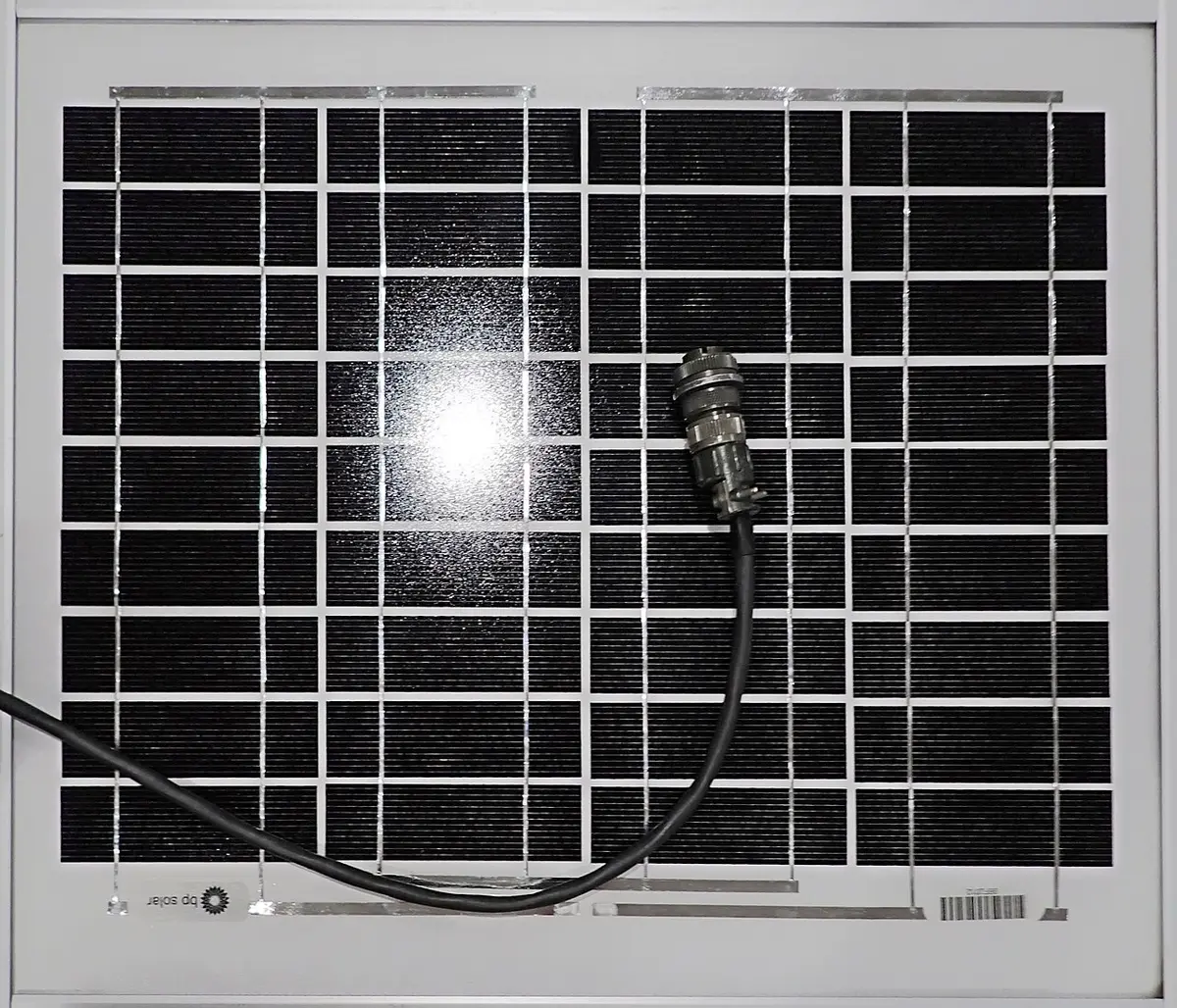
For camping, choose monocrystalline: it converts more sunlight per square foot (roughly 18 to 23 percent efficiency versus 15 to 17 percent for polycrystalline), handles heat and weak light somewhat better, and is what almost every modern folding and portable panel uses. Polycrystalline panels are cheaper per watt and work fine for a fixed, big-roof installation where space is not tight, but they are now uncommon in portable form. When the panel has to fit in a pack, a trunk or a van roof, the extra efficiency of monocrystalline is the point.
The difference comes down to how the silicon is grown. It affects efficiency, size, price, appearance and how the panel behaves in heat and shade. Below is a plain explanation of both types, a comparison table, the numbers that matter for campers, and the questions to ask when a product page says only "high-efficiency solar cells."
How the two types are made
Both types of panel use silicon solar cells, which turn sunlight into direct current through the photovoltaic effect. The difference is the crystal structure of the silicon.
Monocrystalline. Silicon is grown as a single continuous crystal, a large cylinder called an ingot, which is sliced into thin wafers. Because the crystal structure is uniform, electrons move more freely and the cell converts light more efficiently. The wafers are cut from round ingots, so cells often have clipped corners and look uniformly dark, typically black or very dark blue.
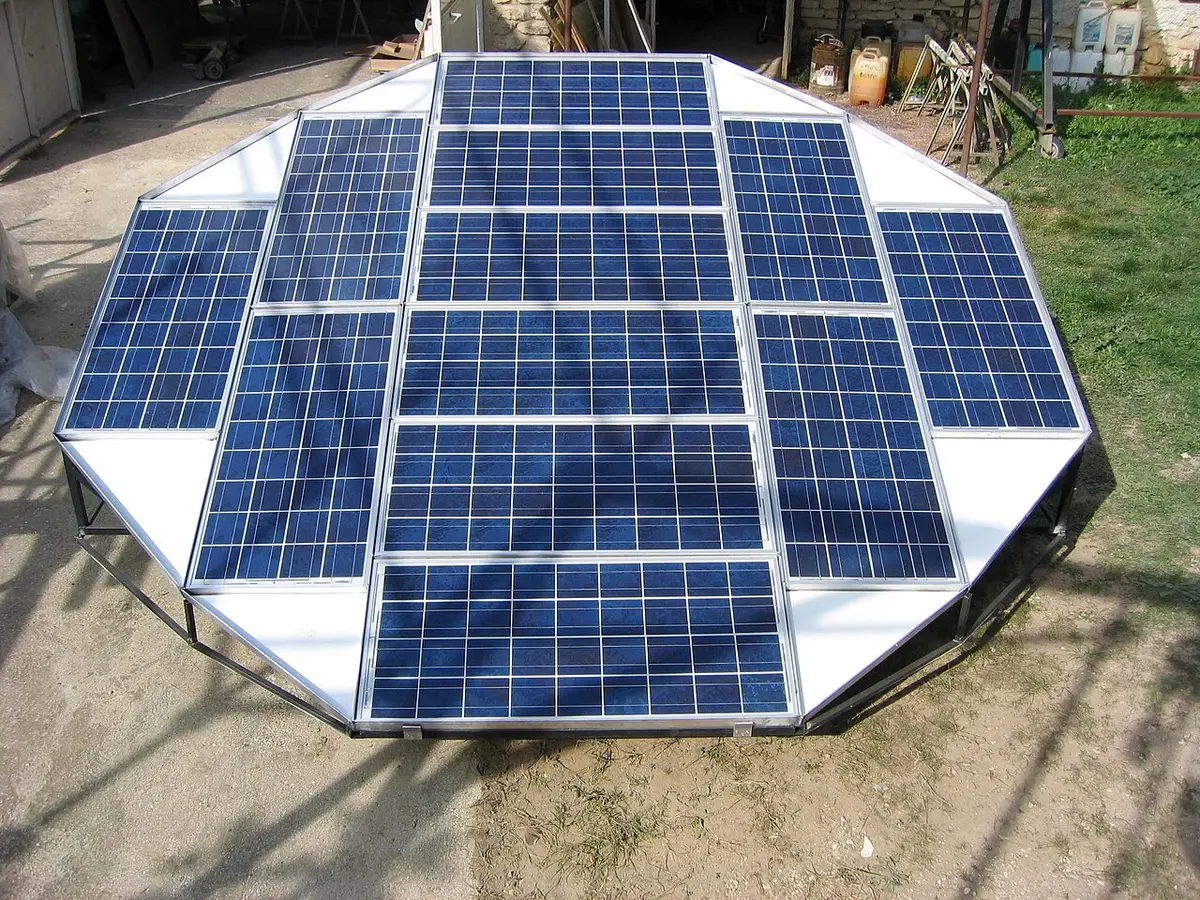
Polycrystalline (also called multicrystalline). Silicon is melted and poured into a square mold, where it cools into many small crystals. The boundaries between crystals impede electron flow slightly, so efficiency is lower. The cells are square, with a blue, speckled look as light reflects off the different crystals.
Both are mature technologies, and both come with long warranties. The practical difference is the amount of sunlight each square foot of panel turns into electricity.
Side-by-side comparison
| Factor | Monocrystalline | Polycrystalline |
|---|---|---|
| Typical efficiency | About 18 to 23 percent | About 15 to 17 percent |
| Output per square foot | Higher | Lower |
| Appearance | Uniform black or dark blue | Blue, speckled |
| Price per watt | Slightly higher, gap now small | Lower |
| Heat tolerance | Slightly better temperature coefficient | Slightly worse |
| Low-light performance | Often a little better | Slightly lower |
| Lifespan | 25 years or more | 25 years or more |
| Availability in portable panels | Standard | Rare |
| Best for | Folding panels, roofs, vans, backpacking | Large fixed arrays with plenty of space |
The efficiency ranges reflect typical commercial panels and vary by manufacturer and model year. As manufacturing improved, mono cell prices fell enough that the cost advantage of poly largely disappeared in many markets, which is why poly has faded from consumer products.
What efficiency means in camp terms
Efficiency is the percentage of sunlight energy that a panel converts to electricity. Under standard test conditions, sunlight delivers about 1,000 watts per square meter, or 93 watts per square foot. A 20 percent efficient panel converts about 18.6 W per square foot, and a 16 percent efficient panel about 14.9 W per square foot.
| Panel wattage | Area needed at 21 percent (mono) | Area needed at 16 percent (poly) |
|---|---|---|
| 50 W | About 2.6 sq ft | About 3.4 sq ft |
| 100 W | About 5.1 sq ft | About 6.7 sq ft |
| 200 W | About 10.2 sq ft | About 13.4 sq ft |
| 400 W | About 20.5 sq ft | About 26.9 sq ft |
For a 100 W panel, the mono version is roughly 1.5 square feet smaller. On a roof, that may decide whether the panel fits. In a pack, it affects the folded size and weight. For a fixed backyard installation, you might not care about the difference at all.
Efficiency does not change energy per rated watt. A 100 W mono panel and a 100 W poly panel will produce the same energy in the same sun if both meet their ratings. What differs is the area and sometimes the weight, as well as performance in heat and dim light.
Heat and low-light behavior
Solar cells lose voltage as they heat up, and the effect is described by the temperature coefficient of power, a negative percentage per degree C on the datasheet. Monocrystalline panels tend to have a coefficient around minus 0.30 to minus 0.40 percent per degree C, while polycrystalline panels run around minus 0.40 to minus 0.50 percent. In practice, a black panel in direct summer sun can reach 60 to 70 degrees C at the cell, which is 35 to 45 degrees above the test condition, so the difference between a coefficient of minus 0.35 and minus 0.45 amounts to a few percent. It is real but small.
Low light is similar. Some mono cells, particularly modern high-efficiency types, start producing power at lower light levels and perform slightly better in the early morning, late afternoon and thin overcast. Claims of dramatic differences should be treated with caution, since good panels of either type produce only a fraction of rated power in heavy cloud. What matters more than crystal type is panel design, cell technology and shading behavior.
The portable panel market: why it is almost all mono
Open the catalog of any camping retailer and you will find portable and folding panels almost entirely made with monocrystalline cells. There are three reasons:
- Space and weight. A portable panel must fold small and be light enough to carry. Higher efficiency means fewer square inches for the same watts.
- Flexible and ETFE-laminated designs. Many folding panels use thin laminates, and mono cells are well suited to those.
- Manufacturing economics. Global production has moved to mono, so the cost gap that once made poly attractive has mostly closed.
Because of this, the choice for campers is less about mono versus poly and more about the panel's construction: rigid glass, folding fabric with cells sewn in, or semi-flexible laminates. Look for good cell encapsulation, a rugged junction box and strong cable strain relief. Check the connector: MC4, DC5521, Anderson or XT60, and what your power station uses. For models with an XT60 connection, see the best foldable solar panels with XT60 connectors. If you want a built-in controller for charging batteries directly, compare the best foldable solar panels with charge controllers.
Cost: what to expect
A decade ago, polycrystalline panels cost noticeably less per watt, which was the reason to choose them. Today, for the small panels campers buy, the price difference is minor or reversed, and what you pay depends more on build quality and brand than on crystal type. Budget guidance:
- Under $100. Small folding panels in the 20 to 60 W range, mostly mono, suitable for phones and small power banks. See the best solar panels under $100.
- $100 to $150. Typically 100 W folding panels or small rigid panels. See the best solar panels under $150.
- $150 to $200. 100 to 200 W panels with better build, and larger folding formats. See the best solar panels under $200.
- $200 to $300. 200 W panels and entry-level 300 to 400 W folding sets, as in the best solar panels under $300.
For particular uses, the best foldable solar panels for backpacking emphasize weight, while the best foldable solar panels for caravans emphasize wattage and ruggedness for a stationary rig.
Other cell technologies you may see
The market has moved on from the simple mono versus poly question. Marketing terms you might see include:
- PERC (passivated emitter and rear cell). A mono cell design with an extra layer that reflects unused light back through the cell, improving efficiency by one to two percentage points.
- N-type, TOPCon and heterojunction (HJT). Newer mono cell technologies with higher efficiency and better temperature behavior, now common in premium panels.
- Half-cut cells. Cells cut in half to reduce resistance losses and improve shade tolerance. They are common on rooftop panels.
- Bifacial. Panels that collect light from both sides, useful on ground mounts over reflective surfaces, rarely useful for camping.
- Thin-film and CIGS. Flexible panel technologies with lower efficiency but good flexibility, used in some roll-up or curved panels.
For campers, the key takeaway is that most of these are variants of monocrystalline cells. If a product page says "monocrystalline PERC" or "N-type," it is a modern mono design.
How to tell what you are buying
Product pages sometimes use vague language. Here is how to find out.
- Look for the cell type in the spec. It should say "monocrystalline," "polycrystalline," or name a specific technology.
- Check the efficiency number. Mono panels usually list 18 to 23 percent or higher, and poly panels 15 to 17 percent.
- Check the appearance. A uniformly black or dark blue panel with clipped corners is mono, while a bright blue speckled one is poly.
- Check the dimensions and weight. A 100 W panel that is unusually large for its wattage may have a lower efficiency.
- Check the temperature coefficient on the datasheet when available.
- Check the warranty. Reputable makers state a power output warranty, such as 80 percent after 25 years for rigid panels, and shorter for folding fabric panels.
- Check the cable and connector. The wrong connector wastes the benefit of a great panel.
Real-world performance factors that matter more
Cell type matters less than what you do with the panel.
- Shading. A shadow across one cell can cut a whole panel's output, because cells are wired in series. Panels with bypass diodes and half-cut cells handle partial shade better.
- Aim. Pointing a panel at the sun can add 10 to 25 percent over a flat placement.
- Temperature. Airflow behind the panel keeps it cooler.
- Wiring. Thin cable wastes power over distance.
- Charge controller. A good MPPT stage harvests more than a basic PWM one, and the difference can exceed the difference between panel types.
- Matching your station. A panel that does not match the input window of your power station performs poorly regardless of cell type.
If you are working out how much panel you need, see how to size a solar panel for camping. For the energy math that follows, watt-hours versus mAh and how long a power station runs a 12V fridge explain how panel output turns into running time.
Worked example: fitting 200 watts on a van roof
A van owner has a usable roof area of about 9 square feet between a vent fan and an air conditioner shroud, and wants as much solar as possible. Here is how the two panel types compare in that space.
At 21 percent efficiency, a monocrystalline panel delivers about 19.5 W per square foot under standard test conditions, so 9 square feet supports roughly 175 W if the panels tile perfectly, and about 150 to 170 W in real life after gaps and frames. At 16 percent efficiency, a polycrystalline panel delivers about 14.9 W per square foot, which supports roughly 134 W in the same space, and about 115 to 130 W after gaps. So on this roof, mono gives about 30 percent more power. If the owner wants a full 200 W, mono comes close and poly never will.
Now count the daily energy. With 4.5 effective sun hours and a 0.75 system derate, 160 W of mono panels deliver about 540 Wh a day, while 125 W of poly deliver about 420 Wh. The difference of 120 Wh a day is equal to running a 12 V fridge for about a third of a day, or charging a laptop twice. Over a season, that is the difference between a battery that stays topped up and one that slowly sags.
The price premium for mono might be $20 to $50 on this scale. If the roof were twice as big, poly could deliver the same watts as mono at a lower cost, and the choice would tilt toward poly. This is the general rule: the tighter your space, the more efficiency pays for itself.
For backpackers, the arithmetic is about weight and folded size. A 28 W mono folding panel might be about the size of a hardcover book when folded and weigh under a pound. A poly panel of the same wattage would be 25 to 30 percent larger. When you carry the pack for miles, that difference is felt.
Quick decision guide
| Your situation | Pick | Why |
|---|---|---|
| Backpacking or bike touring | Monocrystalline folding panel | Weight and folded size |
| Car camping with a power station | Monocrystalline folding or rigid | Fits the trunk, higher watts per square foot |
| Van, caravan or RV roof | Monocrystalline, often rigid | Limited roof area |
| Cabin, shed or ground mount with plenty of space | Either, based on price | Space is not the constraint |
| Temporary or very low budget setup | Used poly or mono panel | Cost matters most |
| Hot climate, panel in direct sun all day | Monocrystalline with a good temperature coefficient | Slightly better heat behavior |
| Cold, bright climate | Either | Cold improves voltage for both, check Voc limits |
Care and longevity
Panels are among the longest-lived pieces of camping electronics, but they are not immortal. Rigid glass panels are robust but heavy, and they can crack from an impact or from stress when mounted unevenly. Folding panels flex at every seam, so the stitching, the hinge areas and the cable entry are the usual failure points. Rinse dust and pollen off with water and a soft cloth, and avoid abrasive cleaners that can scratch the surface. Store folding panels flat or folded as designed, away from heat, and check the cable and connector before each trip. A frayed cable or a corroded contact can cut output more than any difference between crystal types. Over years, expect a slow decline in output of about half a percent a year for good panels, and keep records of the output you measure at the start so you can notice a faster decline.
When polycrystalline still makes sense
Poly panels are not bad. They are efficient enough for many uses, and they have a long track record. They make sense when:
- You are buying an inexpensive used panel for a stationary or temporary setup where space is plentiful.
- You need a rigid panel for a shed, a cabin or a fixed mount, and the price per watt is low.
- You find a second-hand panel at a good price with a clear output history.
For anything you need to carry, fold or fit on a limited roof, monocrystalline is the practical choice.
Common mistakes to avoid
- Choosing by color or type alone. Check watts, efficiency, connector and build quality.
- Assuming a higher efficiency percentage means more power. Wattage tells you power. Efficiency tells you size.
- Paying extra for exotic cell names on a small panel. The benefit is small at camping scale.
- Ignoring the connector. Adapter chains waste power and cause failures.
- Expecting dramatic low-light gains. Heavy cloud cuts output for every panel.
- Leaving panels in a hot vehicle. Extreme heat can damage laminates and cables.
- Buying a rigid panel for a backpack trip. It is too heavy and fragile.
Frequently asked questions
Is monocrystalline better than polycrystalline for camping?
Generally yes. Mono panels are more efficient, which means a smaller, lighter panel for the same wattage, and almost all folding and portable panels are mono. Poly is fine for a fixed installation where space is not an issue.
Do monocrystalline panels work better in cloudy weather?
Slightly, in some cases. Many mono designs begin producing at lower light levels, but all panels lose most of their output under heavy cloud. The difference between types is small compared with the loss caused by clouds.
Are polycrystalline panels cheaper?
They used to be, but the gap has narrowed or disappeared for small panels. Price depends more on build quality, brand and features such as folding and connectors than on crystal type.
How long do solar panels last?
Quality rigid panels are commonly warranted for 25 years with a gradual decline in output, often to about 80 percent. Folding fabric panels have shorter lives because of flexing, stitching and connectors, and commonly come with warranties of one to five years.
Can I tell mono from poly by looking?
Usually. Monocrystalline cells look uniform and dark, often black, with clipped corners on each cell. Polycrystalline cells are square with a blue, speckled, crystalline pattern.
Does the type of panel affect which power station I can use?
Not directly. The station cares about voltage, current and connector, not crystal type. Check the panel's Voc, Vmp and watts against the station's solar input range.
Sources & further reading
- TheGreenWatt: Solar charge controller size calculator
- Renogy: Solar charge controller sizing and how to choose one
Image credits
- "BP Solar 12V solar panel" by JayCubby, CC BY 4.0, via Wikimedia Commons.
- "Photovoltaic panel - Musée du Verre et du Vitrail 3" by Albane46, CC BY-SA 3.0, via Wikimedia Commons.


Ready to buy?
Compare the gear: Camp Power
2 Best Foldable Solar Panels For Backpacking in 2026
Two foldable USB solar panels sized for backpacking, a 28W and a 40W, compared on stated weight, ports, weather rating and how they carry on a pack.
2 Best Foldable Solar Panels For Caravans in 2026
Two foldable solar panels for caravan use compared: a clip-on 100W suitcase for a leisure battery and a slim 200W panel for a portable power station.
5 Best Foldable Solar Panels With Charge Controllers in 2026
Five foldable solar panels that ship with a charge controller, compared on wattage, controller type, cable length and weight for 12V battery charging.
2 Best Foldable Solar Panels With Xt60 Connectors in 2026
Two foldable solar panels that list XT60 connectors, a 400W and a 200W, compared on voltage, weight, kickstands and station compatibility.
5 Best Solar Panels Under 100 in 2026
Best solar panels under $100: five 100 to 150W rigid and foldable panels compared on bifacial design, controllers, voltage and carry size for RVs and camps.
5 Best Solar Panels Under 150 in 2026
Best solar panels under $150: five 100 to 200W flexible, rigid and portable panels compared on watts per dollar, weight and mounting for vans and RVs.
5 Best Solar Panels Under 200 in 2026
Best solar panels under $200: five 200W rigid, bifacial and portable panels compared on cell type, voltage, USB ports and weight for RVs and stations.
5 Best Solar Panels Under 300 in 2026
Best solar panels under $300: five 200 to 300W foldable, flexible and kit panels compared on weight, bend, controllers and connectors for RVs and camps.
Keep reading