

We research everything we recommend. When you buy through our links, we may earn a commission. Learn more

Buying guide · 10 min read · Updated October 2, 2026

5 Best RV Solar Battery Maintainer in 2026: A Practical RV Guide

Five 12V solar battery maintainers for stored RVs, from 7.5W to 30W panels, with watt-hour math for self-discharge and charge controller notes.

Bowen HigginsBy Bowen HigginsRV Editor at RV Gear Lab5 products comparedSpec-sheet researched

At a glance

Our top picks

A solar battery maintainer is not a charger for a dead bank. It exists to offset self-discharge and small parasitic drains while an RV sits in storage, so the right panel size depends on the battery and the drain. Most stored RV batteries lose a few amp-hours a week, and a small panel behind a window or on the dash can cover that. These five picks run from 7.5W to 30W, and the sizing notes show how to match panel watts to what your battery actually loses.

RV Gear Lab field notes

The Rig Fit Check

Start with the job
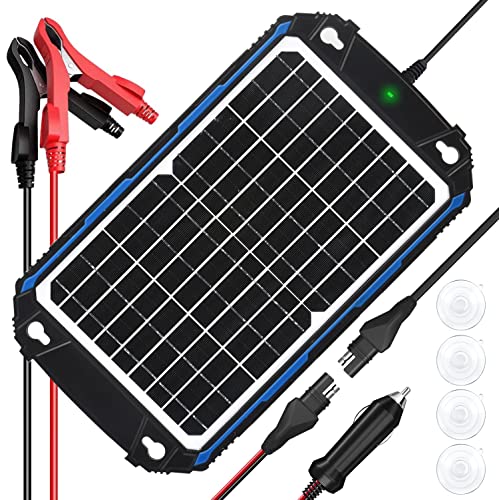
SUNER POWER 20W 12V Solar Battery Trickle Charger & Maintainer PRO leads this shortlist for Shaded storage with a lead acid bank. Use that fit as a reference point, then compare the alternatives against your own space and workload.
Specs that separate the picks
The first details to compare are 20W panel, 12V, 30W monocrystalline panel, 12W panel, waterproof. Confirm the exact model and included components before ordering.
Trade-off to plan for
Panel dimensions are not listed

Before you buy

What Matters Before You Choose an RV Solar Battery Maintainer

Key buying criteria so you get the right fit the first time.

  1. 01

    Panel watts vs self-discharge

    A lead acid battery loses roughly 3 to 5 percent a month, plus parasitic drains. A 100Ah battery loses about 4Ah a month, so even 5W can offset it. Add your alarm and monitor draws.

  2. 02

    Controller type

    The controller decides how much of the panel's power reaches the battery. MPPT controllers track the panel's best voltage and extract more energy in weak or partial light, while basic controllers just regulate. Look for MPPT named in the listing, and if it is not listed, assume a basic controller and buy a bigger panel to compensate.

  3. 03

    Float and restart behavior

    A good maintainer stops charging when the battery is full, then restarts when voltage drops, so it never cooks the cells over months of storage. Without float control, a small panel can still overcharge a small battery in strong sun. Look for float, overcharge protection or auto restart wording in the listing before leaving it connected for the winter.

  4. 04

    Weather resistance

    Outdoor storage needs a sealed controller. IP67 potting is the strongest rating here. Check the listing.

  5. 05

    Battery chemistry

    Lithium iron phosphate, AGM and flooded lead acid batteries each want a different charge voltage profile, and a wrong setting shortens battery life or leaves it undercharged. Charging a lithium bank on a lead acid profile is a common and costly mistake. Look for LiFePO4 or your chemistry named in the listing, and confirm the settings are adjustable.

Our standards

Why You Can Trust RV Gear Lab

At RV Gear Lab, we compare products based on rig fit and power or hookup compatibility, verified specifications, usability, setup requirements, weight, durability, and real-world trade-offs. We do not rank products purely on marketing claims or commission rates.

We have not personally tested every product listed. Where hands-on testing is not available, recommendations are based on verified manufacturer specifications, product documentation, use-case fit, and comparative research.

How we review RV gear →

Detailed reviews

The 5 best rv solar battery maintainer, explained

01
Best for: Shaded storage with a lead acid bank

Our take

It costs $25.96 more than the SUNER 12W and $29.00 more than the Voltset 30W while giving less panel wattage than the Voltset.

Why it made the shortlist

The SUNER POWER 20W is a 12V solar trickle charger and maintainer with built-in MPPT, a 3-stage Bulk, Absorption, Float algorithm and overcharge, over-discharge and over-voltage protection.

You are paying for the MPPT controller. Pick this if your RV sits in partial shade or you want the most efficient small controller.

What works

  • MPPT controller extracts more power in weak light
  • Stops at full charge and restarts automatically
  • Overcharge and over-discharge protection built in

Watch out for

  • Panel dimensions are not listed
02
Best for: Outdoor storage with a bigger battery

Our take

You trade the MPPT controller for more panel.

Why it made the shortlist

The Voltset 30W has an IP67 fully potted smart controller, A+ monocrystalline cells, 3-stage charging and overcharge, deep discharge and short circuit protection. At $56.95 it offers the largest panel for the price and the best moisture resistance.

Pick this if you want the most watts and a waterproof controller for outdoor storage.

What works

  • 30W gives the most power for the money
  • IP67 controller resists moisture and rain
  • Monocrystalline cells work better in low light

Watch out for

  • Larger panel is harder to mount
  • Weight is not listed
03
Best for: Single small battery in storage

Our take

It costs $25.96 less than the SUNER 20W and $3.04 more than the Voltset 30W.

Why it made the shortlist

The SUNER POWER 12W is a waterproof 12V maintainer with the same Ultra-Smart MPPT and 3-stage algorithm as the 20W.

Pick this if you have one small battery and want the MPPT at a lower price.

What works

  • MPPT charge control for under $60 in a small panel
  • Waterproof build suits outdoor storage in rain and snow
  • Same 3-stage algorithm as the 20W model

Watch out for

  • 12W is thin for big batteries
  • Parasitic drains like alarms can outrun a 12W panel
The catch
At $59.99 it offers MPPT control in a smaller panel.
04
Best for: Light-duty trailer battery

Our take

It costs $10.00 more than the POWOXI 7.5W and $10.00 less than the SUNER 12W.

Why it made the shortlist

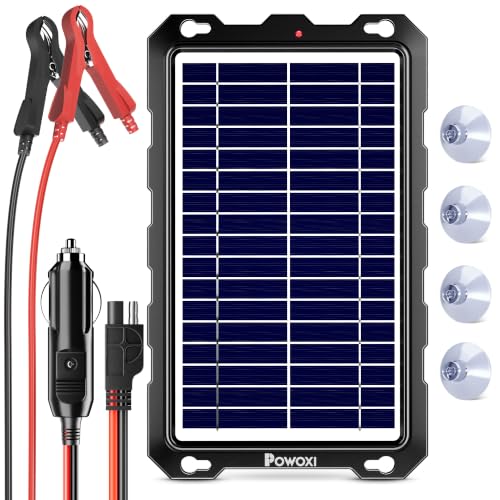
The POWOXI 9W has a glass-faced panel in an ABS and PC frame with an internal protection controller, listed for car, marine and trailer use. At $49.99 it is a simple dash or tongue maintainer.

You get 1.5W more panel. Pick this if you want a basic set-it-and-forget-it unit.

What works

  • High-transparency glass panel resists scratches during dash mounting
  • Rigid frame needs no extra backing
  • Simple plug-and-forget operation with no settings to adjust

Watch out for

  • No MPPT listed, so weak light output is lower
  • 9W is small for RV banks
05
Best for: Small battery self-discharge only

Our take

It costs $10.00 less than the POWOXI 9W and $20.00 less than the SUNER 12W.

Why it made the shortlist

At $39.99 it is the lowest priced unit with a glass panel here.

What works

  • Rigid ABS and PC frame survives dash mounting
  • Internal protection controller prevents overcharging the battery

Watch out for

  • 7.5W is the smallest panel here
  • No MPPT listed, so weak light output is lower
The catch
The POWOXI 7.5W is the smaller sibling, with the same glass panel, rigid frame and protection controller.

Methodology

How We Built This Shortlist

Each pick was assessed across 4 criteria weighted for real-world use.

01

Panel watts vs drain

We compared panel wattage to the daily watt-hours a stored battery loses.

02

Controller type

We separated MPPT controllers from basic ones and noted weather resistance.

03

Mounting and build

We looked at frame, glass and cable details named on each listing.

04

Value

We compared price per panel watt.

Decision guide

Match an RV Solar Battery Maintainer to Your RV

By Battery Size

Your situationRecommended pickWhy
Single small battery, no parasitic drainPOWOXI 7.5WEnough to offset self-discharge
Single group 27 batteryPOWOXI 9WA little more margin
Two batteries or light parasitic drainSUNER 12WMPPT squeezes more from weak light
Larger bank or long storageVoltset 30WMost panel watts for the price

By Budget

BudgetRecommended pick
$30 to $50POWOXI 7.5W or POWOXI 9W
$50 to $60Voltset 30W or SUNER 12W
$80 to $90SUNER 20W

MPPT Controller vs More Panel

MPPT controller

Better in weak or partial light. SUNER 20W and SUNER 12W use it.

More panel

More raw watts for less money. Voltset 30W is the example.

Most owners with open-sky storage should default to the Voltset 30W.

By Storage Location

Best pickRecommended pick
Parked in shade or behind glassSUNER 20W
Open driveway or lotVoltset 30W
Dashboard of a stored unitPOWOXI 9W

For Winter Storage Specifically

Look for

Panel watts of at least 5 to 10 percent of battery amp-hours and a controller that stops at float.

In this comparison

Voltset 30W covers a 100Ah battery with room to spare; SUNER 20W is better in partial shade.

When to Spend More

Spend more if

Spend more on the SUNER 20W if storage is shaded and you want MPPT.

Save if

Save with the POWOXI 7.5W for a small battery in direct sun.

FAQ

Before You Bring One Home

Will a 7.5W panel maintain an RV battery?

Only a small one with no parasitic drains.

Is MPPT necessary?

Helpful in shade; not needed in full sun.

Can I leave it connected all winter?

Yes, since the controllers stop at float.

Does it work through a window?

Output drops sharply, so use a larger panel.

Does it charge a dead battery?

No, it only maintains.

Bottom line

The short version

Browse more rv solar battery maintainer on Amazon →
Bowen Higgins, RV Editor at RV Gear Lab

About the author

Bowen Higgins

RV Editor at RV Gear Lab

Bowen covers RV power, water systems, towing and leveling, upkeep and interior comfort, with a focus on matching gear to the rig, the hookups and the way you actually travel.

More from Bowen →Editorial standards

Keep reading

Related guides