
Practical Camping Guide · 12 min read
Deep Cycle vs Starting Battery: What Campers Need
Learn how deep cycle and starting batteries differ, how to size a camping battery and why AGM or lithium suits fridges, lights and inverters.

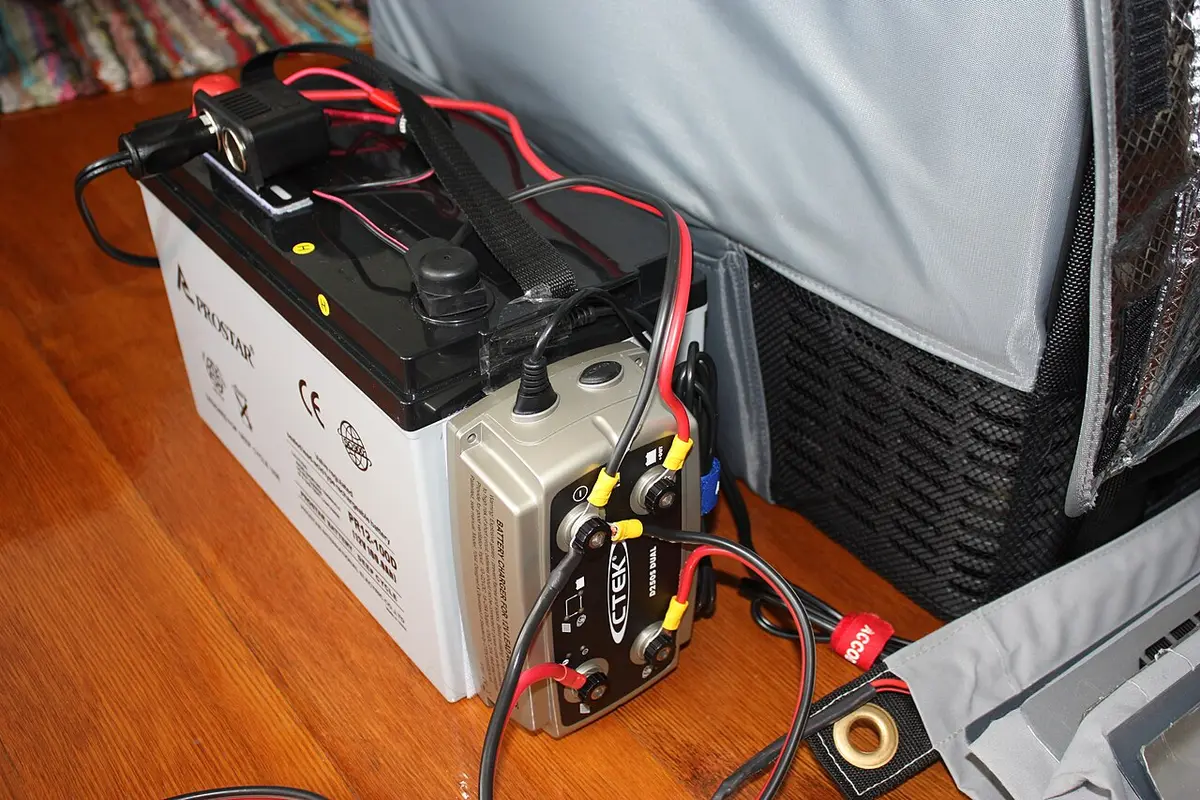
A starting battery delivers a huge burst of current for a few seconds to crank an engine, then gets topped up by the alternator, and it is damaged by deep discharges. A deep cycle battery delivers modest current for hours and is built to be drained to 50 percent (lead-acid) or lower (lithium) again and again. For running lights, a fridge, a fan, a CPAP or an inverter at camp, you want a deep cycle battery. Use the starting battery only to start the engine, and keep the two separate with a battery isolator or a DC-DC charger.
Mixing up the two is one of the most common and expensive camper mistakes. Campers run a fridge off the vehicle's starting battery overnight and find a dead truck at sunrise, or buy a cheap "marine" battery without checking that it is a true deep cycle design. Below is how the two designs differ, how to size a deep cycle battery, how the chemistries compare, and how to wire a setup that does not leave you stranded.
The core difference: thick plates versus thin plates
Inside a lead-acid battery, current is generated by chemical reactions on lead plates. Surface area decides how much current the battery can deliver at once, and the thickness of the plates decides how well it tolerates deep discharge.
- Starting (cranking) batteries use many thin plates, which give a large total surface area. That allows enormous current for a short time: 400 to 900 cold cranking amps (CCA) for a car or truck. Thin plates, however, shed active material when deeply discharged and cycled, so they fail quickly under camping duty.
- Deep cycle batteries use fewer, thicker plates with dense active material. They deliver lower peak current but sustain it for hours and survive hundreds of discharge cycles.
- Dual purpose or "marine" batteries sit between the two. They have a medium plate design and can both crank an engine and handle moderate cycling, but they do neither as well as a dedicated design.
A starting battery used for camping loads may last only 30 to 80 deep cycles before failing, while a quality deep cycle battery lasts 300 to 1,000 cycles at 50 percent depth of discharge, depending on type and treatment.
Which ratings matter
Read the label for the numbers that match the job.
| Rating | What it means | Matters for |
|---|---|---|
| CCA (cold cranking amps) | Current the battery can deliver at 0 degrees F for 30 seconds without falling below 7.2 V | Starting batteries |
| MCA or CA (marine or cranking amps) | Same test at 32 degrees F, a higher number | Starting, marine |
| Ah (amp hours) | Capacity, usually at the 20-hour rate | Deep cycle |
| RC (reserve capacity) | Minutes the battery can deliver 25 A to 10.5 V | Both, deep cycle useful |
| Cycle life | Number of charge cycles to a stated depth of discharge | Deep cycle |
| Weight | Pounds, a rough proxy for plate mass | Both |
For a camping battery, Ah and cycle life matter far more than CCA. A deep cycle battery's CCA is often low or not even listed, and that is fine. The numbers to check are capacity, depth-of-discharge rating, and the warranty.
Types of deep cycle batteries
| Type | Maintenance | Usable capacity | Cycle life (approx.) | Weight (100 Ah) | Notes |
|---|---|---|---|---|---|
| Flooded lead-acid | Add distilled water, vent gases | About 50 percent | 300 to 500 | 55 to 65 lb | Cheapest, needs ventilation |
| AGM (absorbed glass mat) | None | About 50 percent | 400 to 800 | 60 to 70 lb | Sealed, spill-proof, popular |
| Gel | None | About 50 percent | 500 to 1,000 | 60 to 70 lb | Sensitive to charge voltage |
| LiFePO4 lithium | None | 80 to 100 percent | 2,000 to 5,000 | 25 to 30 lb | Higher cost, needs lithium-aware charging |
These are typical ranges, and brand and quality change them a lot. The comparison shows why lithium has taken over serious camping setups: a 100 Ah lithium battery delivers around 80 to 100 Ah of usable energy, while a 100 Ah lead-acid battery yields about 50 Ah if you want it to last. Lithium is also lighter, charges faster and holds voltage under load. The chemistry trade-offs for lithium packs are covered in more depth in the lithium chemistry comparison for power stations, though the pack types differ in structure from stationary batteries.
For buyers on a budget, AGM is the practical middle: sealed, mountable in any orientation, and available in many sizes. See the best AGM deep cycle batteries and the best deep cycle batteries for RVs for fits and sizes. If you want lithium on a budget, the best budget lithium deep cycle batteries shows where that market sits.
Depth of discharge: the rule that decides lifespan
Depth of discharge (DoD) is how much of the battery's capacity you use before recharging. Lead-acid batteries age fastest when drained deeply, and the standard guidance is to keep them above 50 percent state of charge, which is about 12.1 to 12.2 V at rest for a flooded or AGM battery. Dropping to 20 percent regularly can cut life to a fraction of the rated cycles. Lithium iron phosphate batteries tolerate deep discharge much better, with 80 to 100 percent DoD routinely rated.
| Battery type | Resting voltage at full | Resting voltage at 50 percent | Resting voltage at empty |
|---|---|---|---|
| 12 V flooded or AGM | 12.7 to 12.8 V | 12.1 to 12.2 V | About 11.8 V |
| 12 V gel | 12.8 to 12.9 V | 12.2 V | About 11.9 V |
| 12.8 V LiFePO4 | 13.4 to 13.6 V | About 13.1 V (voltage curve is flat) | About 12.0 V under load |
Voltage is a rough guide for lead-acid and a poor guide for lithium, which holds near-constant voltage until it nears empty. For lithium, a battery monitor with a shunt that counts amp-hours in and out is the right way to read state of charge.
How big should a camping battery be?
Start with daily watt-hours (the watt-hours versus mAh explainer covers the unit conversions). A 12 V fridge that uses 300 to 400 Wh a day, plus lights, phone charging and a fan at 100 Wh a day, gives 400 to 500 Wh a day. For a lead-acid battery at 50 percent usable depth, divide by 12 V and then by 0.5: 450 Wh / 12 V = 37.5 Ah per day of use, so you need about 75 Ah for one day between charges, or 150 Ah for two days. For lithium at 80 percent usable, the same load needs about 47 Ah per day, so 100 Ah gives you two days.
Use the table to find a starting point:
| Daily use | Lead-acid (AGM) for one day | Lithium for one day |
|---|---|---|
| Light: lights, phones, fan, 150 Wh | 25 to 30 Ah | 15 to 20 Ah |
| Medium: plus laptop, 300 Wh | 50 to 60 Ah | 30 to 40 Ah |
| Fridge and medium, 500 Wh | 85 to 100 Ah | 50 to 60 Ah |
| Fridge, CPAP, medium, 800 Wh | 130 to 160 Ah | 80 to 100 Ah |
| Plus inverter loads, 1,200 Wh | 200+ Ah | 120 to 150 Ah |
Add a margin for cold, inverter losses and cloudy days. If you recharge with solar, link battery size to panel output, using the approach in how to size a solar panel for camping. For help estimating the daily draw of a fridge, see how long a power station runs a 12V fridge.
Budget tiers and what to expect
Price shapes what you can reasonably expect from a camping battery. Below about $150, you are generally in the range of smaller AGM or flooded batteries with a capacity of 35 to 75 Ah. Between $150 and $300, 100 Ah AGM batteries become common, and entry-level lithium appears at the higher end. Past $300, you reach better AGMs, larger capacities and mainstream lithium, and above $500 you see premium lithium with built-in heaters, Bluetooth monitoring and a strong warranty.
Browse by budget in the lists for deep cycle batteries under $150, under $200, under $300, under $500 and under $750. Remember that the cheapest battery per amp-hour is not the cheapest per usable cycle. A 100 Ah AGM at $200 with 400 cycles delivers roughly 240 kWh over its life, while a lithium battery at $500 with 3,000 cycles delivers closer to 3,000 kWh at a far lower cost per kilowatt-hour.
Keeping the starting battery safe
The risk with deep cycle camping is draining the battery that starts your engine. There are three common arrangements.
- Separate batteries, no connection. A standalone deep cycle battery powers your camp gear and is charged at home or by solar. Nothing can drain the starter. This is the simplest, safest layout for tent camping and short trips.
- Battery isolator or voltage-sensing relay (VSR). A VSR connects the two batteries when the engine is running (and the starter battery is charged) and disconnects them when the engine stops. This is the classic dual battery setup for trucks and boats.
- DC-DC charger. A smart charger takes power from the starter battery and delivers a controlled charging profile to the auxiliary battery. It is the right choice for lithium auxiliary batteries and long wire runs, since alternators in modern vehicles often have variable voltage and will not charge lithium properly through a simple relay.
Whatever the layout, fuse the cables near each battery, size the wire for the current, and keep batteries secured. A loose 60 pound battery in a collision is a hazard.
Charging: the part most people get wrong
Batteries die more often from poor charging than from heavy use. A flooded or AGM battery needs a charger with bulk, absorption and float stages, typically about 14.4 V for absorption and 13.5 V for float at 77 degrees F. A basic trickle charger or a vehicle alternator in short drives may never fully charge a deep cycle battery, leading to sulfation, a hard crust on the plates that reduces capacity permanently.
Lithium batteries need a charger with the correct profile (commonly 14.2 to 14.6 V with no long float). Charging below freezing damages lithium cells, so many have a low-temperature cutoff or a built-in heater. For solar, use a charge controller with settings for your battery type, such as AGM or lithium, to prevent over- or under-charging.
Charge at the recommended rate, often between 10 and 30 percent of the battery's Ah rating for lead-acid (10 to 30 A for a 100 Ah battery) and higher for lithium if the maker allows it. Overcharging flooded batteries produces hydrogen gas, so ventilate the space, and do not charge in a closed box.
Reading a battery label before you buy
Battery listings are crowded with numbers, and some are more honest than others. Here is how to cut through them.
- Find the Ah rating and the rate it is measured at. Most are quoted at the 20-hour rate, meaning the battery delivers its Ah over 20 hours. At higher currents the usable capacity falls, a behavior known as Peukert effect. A 100 Ah AGM battery pulled at 100 A may deliver only 60 to 70 Ah before reaching cutoff.
- Look for the stated cycle life and the depth of discharge it applies to. "1,000 cycles" means little without "at 50 percent DoD".
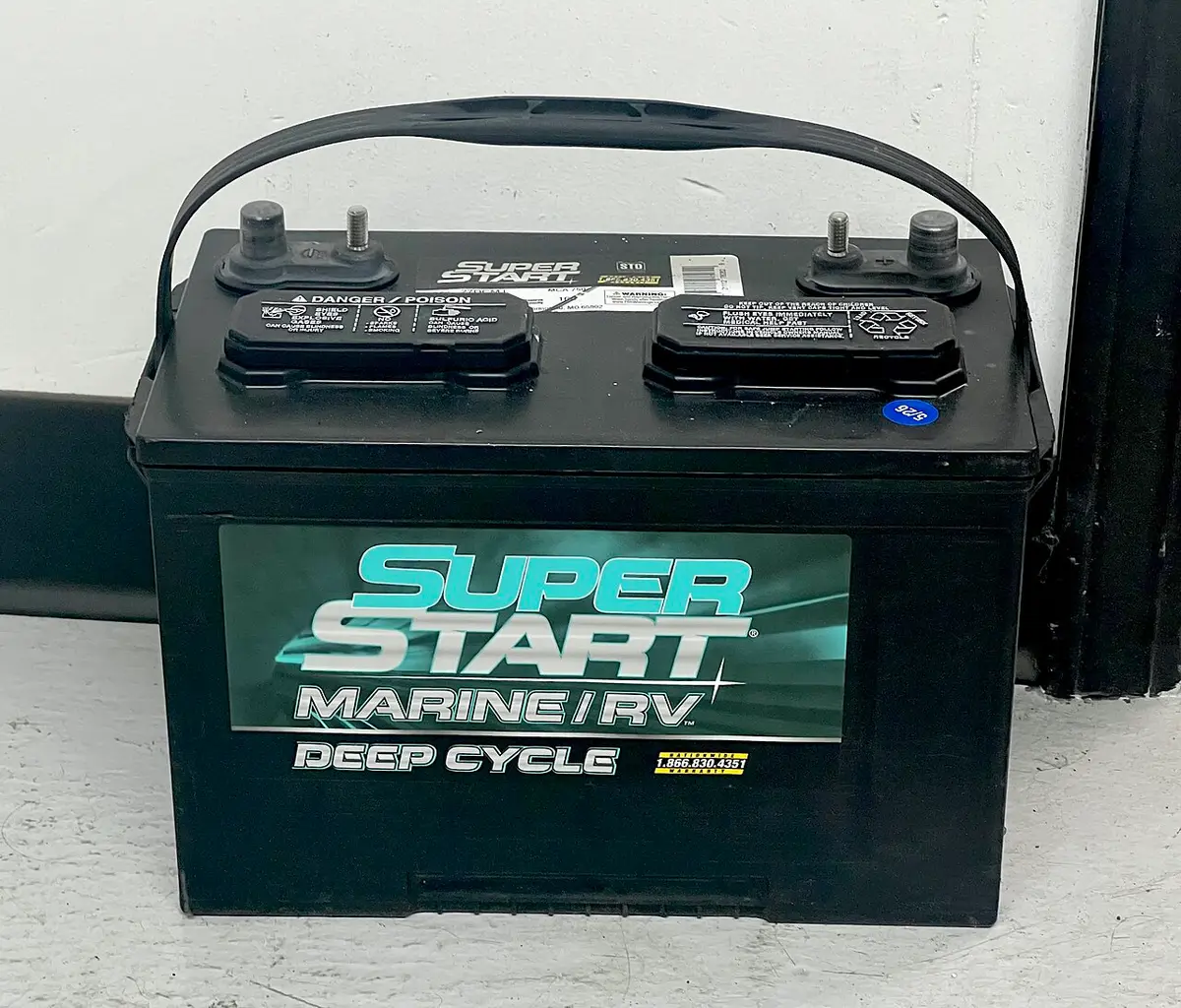
- Check the group size or dimensions. Group 24, 27 and 31 are common batteries that fit standard trays. A mismatched size means a custom bracket.
- Check the weight. A 100 Ah AGM that weighs 40 pounds has less lead than one that weighs 65, and it will likely deliver less capacity or last less long.
- Read the warranty. A free replacement for one year and a prorated period beyond signals more confidence than 90 days.
- Look for the terminal type. Standard posts, threaded studs or side terminals change the cables you need.
- Confirm lithium-specific details. For lithium, look for the BMS current limit, the low-temperature charge protection, whether series or parallel connection is supported, and whether Bluetooth monitoring is included.
Series versus parallel: building a bigger bank
Two 12 V batteries wired in parallel (positive to positive, negative to negative) give 12 V at double the Ah. Wired in series, they give 24 V at the same Ah. Camper systems at 12 V almost always use parallel connections to add capacity. Use identical batteries of the same age, type and capacity, and connect them with cables of equal length so that current shares evenly. A mismatch makes one battery work harder and age faster.
Many people ask whether to buy one 200 Ah battery or two 100 Ah batteries. One larger battery has fewer connections and less wiring to fail. Two smaller batteries are easier to lift and install, and you can replace one if it fails, though ideally you replace both. For lithium batteries, check whether the manufacturer approves parallel connections, since a poorly managed bank can create imbalances that trip the BMS.
Storage and winter care
A fully charged lead-acid battery tolerates winter better than a partly discharged one, because discharged batteries can freeze at temperatures just below 32 degrees F. Store lead-acid batteries fully charged in a cool, dry place, and top them up every month or two or keep a maintenance charger on them. Flooded batteries lose water over time, so check electrolyte levels and add distilled water.
For lithium, store at around 50 percent charge in a cool place, and check every few months. Never charge a frozen lithium battery. If the battery has a battery management system, check that it is in storage mode if there is one.
Common mistakes to avoid
- Running the fridge off the starting battery. A starter battery can be left too weak to crank after a few deep cycles.
- Treating a "marine" label as a guarantee of deep cycle design. Check the Ah and cycle ratings, not just the sticker.
- Ignoring the charger. The wrong charge profile ruins either chemistry.
- Mixing old and new batteries in one bank. The weaker battery drags the rest down.
- Skipping the fuse. A short on a 12 V battery can deliver hundreds of amps.
- Using voltage to read lithium state of charge. The flat curve makes voltage unreliable, so use a monitor.
- Under-sizing capacity. Draining lead-acid below 50 percent shortens life dramatically.
Frequently asked questions
Can I use a deep cycle battery to start my engine?
Sometimes, but it is a poor fit. Deep cycle batteries are built for steady current, not the surge needed to crank an engine, so they may struggle in cold weather. A dual purpose battery is a compromise. For reliability, use a starting battery to start and a deep cycle for house loads.
How long will a 100 Ah deep cycle battery run a fridge?
A 12 V compressor fridge that uses 350 Wh a day uses about 29 Ah a day. A 100 Ah AGM battery with 50 Ah usable gives roughly 1.7 days. A 100 Ah lithium battery with 80 to 100 Ah usable gives about 2.7 to 3.4 days, before solar or alternator charging.
Is lithium worth the higher price over AGM?
For frequent use, yes. Lithium gives about twice the usable capacity per rated Ah, weighs less than half as much, and lasts several times more cycles. For occasional weekend use, a good AGM battery is a sensible and cheaper option.
Can I charge a deep cycle battery from my vehicle's alternator?
Yes, through a battery isolator, a VSR or a DC-DC charger. A DC-DC charger is best, especially for lithium and for vehicles with smart alternators that vary voltage. Direct parallel connection without a protective device risks draining the starter battery.
How do I know when a deep cycle battery is failing?
Common signs include a drop in runtime, a voltage that sags quickly under load, a battery that will not hold a full charge, swelling, and a rotten egg smell from overheated lead-acid cells. A load test or a capacity test with a monitor tells you the real capacity compared to the rated one.
What size wire do I need between the battery and an inverter?
It depends on the inverter's wattage and cable length. A 1,000 W inverter at 12 V draws about 90 A and typically needs 2 AWG to 4 AWG cable for a short run, with a fuse of 125 to 150 A near the battery. Check the inverter manual and a wire gauge chart for your length.
Sources & further reading
- Battery University: How to prolong lead-acid batteries
- Battery University: Types of lithium-ion batteries
- Renogy: mAh to Wh conversion guide
Image credits
- "Auxiliary Battery & CTEK charger" by Stephan Ridgway from Brisbane, Australia, CC BY 2.0, via Wikimedia Commons.
- "Super Start Marine RV Deep Cycle Battery" by TaurusEmerald, CC BY-SA 4.0, via Wikimedia Commons.


Ready to buy?
Compare the gear: Camp Power
6 Best Deep Cycle Batteries Under 150 in 2026
Best deep cycle batteries under $150: six 12V AGM, gel and LiFePO4 batteries from 35Ah to 100Ah compared on capacity, weight and cycle life for camping.
6 Best Deep Cycle Batteries Under 200 in 2026
Best deep cycle batteries under $200: six 12V lithium, AGM and gel batteries from 75Ah to 120Ah compared on capacity, cranking power and weight.
6 Best Deep Cycle Batteries Under 300 in 2026
Best deep cycle batteries under $300: six 12V lithium and AGM batteries from 90Ah to 300Ah compared on capacity, BMS rating and cranking power.
6 Best Deep Cycle Batteries Under 500 in 2026
Best deep cycle batteries under $500: six 12V and 6V batteries from 100Ah to 300Ah compared on chemistry, expandability and cold-weather behavior.
6 Best Deep Cycle Batteries Under 750 in 2026
Best deep cycle batteries under $750: six 12V and 6V batteries from 64Ah to 300Ah compared on expandability, temperature range and dual-purpose use.
6 Best Budget Lithium Deep Cycle Batteries in 2026
Six budget 12V 100Ah LiFePO4 deep cycle batteries compared on group size, BMS rating and cold-weather charging for RV and camp power banks.
6 Best Agm Deep Cycle Batteries in 2026
Best AGM deep cycle batteries for camping compared on capacity, group size, self-discharge and dual-purpose starting, from 35Ah to 200Ah.
4 Best Deep Cycle Batteries For Rvs in 2026
Best deep cycle batteries for RVs compared on chemistry, group size, weight, cold-charging limits and 12V 100Ah capacity for house banks.
Keep reading